REAAP Overview: COMESA Fact Sheet
- Home
- REAAP Overview: COMESA Fact Sheet
Introduction
The Accelerating Sustainable and Clean Energy Access Transformation (ASCENT) Multi-Programmatic Approach (MPA) is an ambitious leap toward universal energy access and the clean energy transition in the Eastern and Southern Africa (AFE) region. The ASCENT program is designed to be transformative in a region where an estimated 48% of the total population, and only 26% in rural areas, currently has access to electricity.
ASCENT serves as a comprehensive accelerator of energy access efforts in the AFE region, targeting the delivery of new electricity connections for 100 million people through both grid-based and Distributed Renewable Energy (DRE) solutions. The program will leverage the proposed International Development Association (IDA) envelope of US$5 billion, underscoring the World Bank’s commitment to achieving SDG7 in Eastern and Southern Africa and mobilize an additional US$10 billion from development partners, governments, national utilities, private-sector and commercial financiers, carbon markets, climate-oriented investors, philanthropies, and other stakeholders.
The MPA is IDA-financed and anticipates participation from up to 20 countries in the AFE region. IDA-eligible countries will have access to financing under the US$5 billion ASCENT envelope, while IBRD countries with energy access deficits (Angola, Botswana, Eswatini, Namibia, and South Africa) may also participate through IBRD borrowing, as well as by leveraging climate finance instruments, carbon financing platforms, and private-sector engagement.
Program Developement Objective and MPA
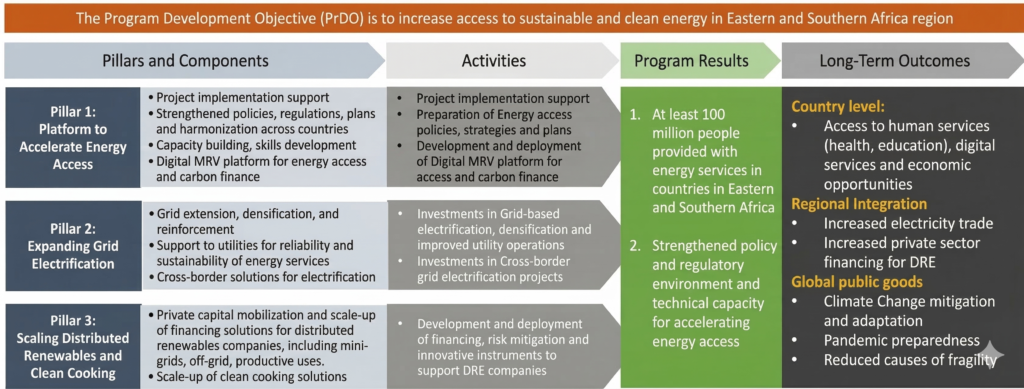
The Program Development Objective, to which participating countries and regional institutions will contribute, is to increase access to sustainable and clean energy in Eastern and Southern Africa. This includes access to on-grid and off-grid (DRE) electricity solutions as well as clean cooking.
i. A regional mechanism for coordination and harmonization. ii. Aggregation to mobilize capital and achieve economies of scale. iii. Agile implementation, with reduced transaction costs in both the design and execution of AFE interventions, benefiting all participating countries.
ASCENT Program Theory of Change
Project Beneficiaries
The primary beneficiaries of ASCENT are people across the AFE region, particularly women, who will gain access to sustainable electricity and clean cooking solutions. Improved energy access will generate broad socio-economic benefits.Women, who are disproportionately burdened by the lack of energy access (especially for household cooking), will benefit from targeted opportunities for income generation and employment.
Regional Energy Access Acceleration Platform under ASCENT MPA
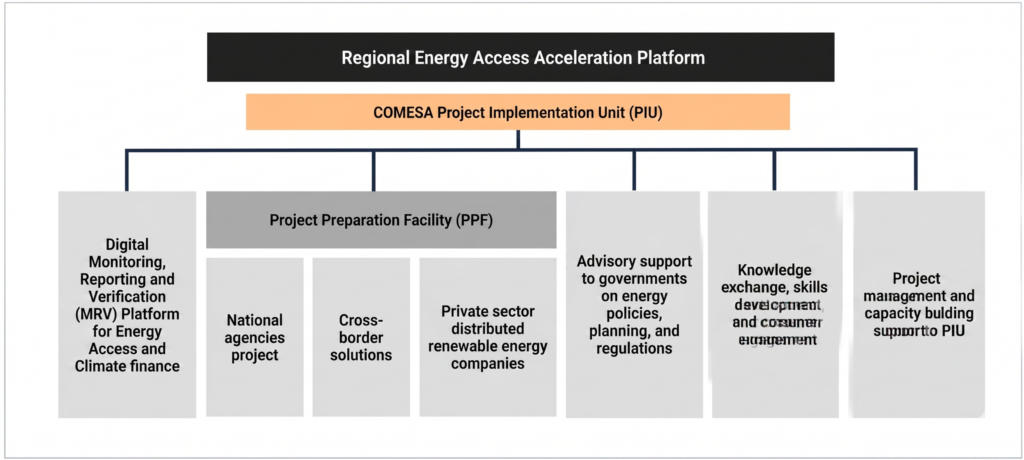
COMESA will implement the US$50 million Regional Energy Access Acceleration Platform, which will support all ASCENT MPA participant countries, including both COMESA and non-COMESA members. It will provide support to countries that have joined the ASCENT program, as well as those that are preparing their projects for program entry. Support will be provided to governments, national utilities, agencies, and private-sector service providers, with particular emphasis on distributed renewable energy and clean cooking sectors.
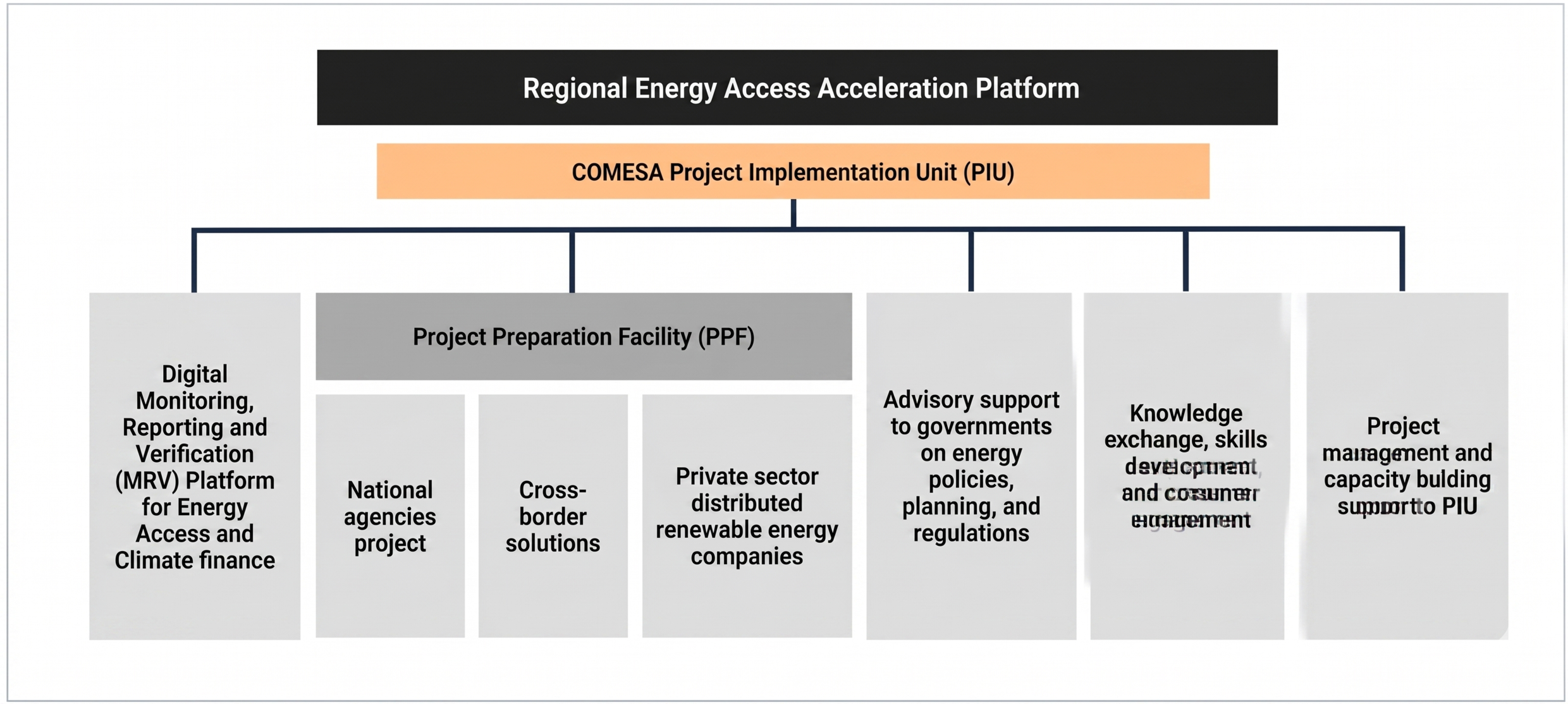
a. Regional Digital Monitoring, Reporting, and Verification (D-MRV) Platform for Energy Access
ASCENT aims to deploy a regional Digital-Monitoring Reporting and Verification Platform D-MRV platform to monitor country-level implementation progress and aggregate data across participating countries. To ensure interoperability, countries will be supported in aligning national systems with the regional platform. The Secretariat will focus on adopting a platform that meets these requirements, complemented by digital solutions for planning, implementation, and MRV.
b. Project Preparation Facility (PPF)
The PPF, a critical component of ASCENT, will support governments and the private sector in developing bankable, investment-ready projects. Support will be demand-driven and delivered as technical assistancegrants to eligible companies selected through competitive calls for proposals.
c. Advisory Support Facility
This facility will strengthen the policy and regulatory environment for energy access by:
i. Supporting governments in preparing, updating, and operationalizing electrification and clean cooking strategies and plans.
ii. Preparing regional and country-specific energy-access investment prospectuses and roadmaps, and facilitating convenings and roadshows to mobilize financing.
iii. Promoting the adoption of best practices in energy policies.
d. Knowledge Exchange, Skills Development, Consumer Engagement, and Partnerships
This component will enhance data, knowledge, and skills for energy-access planners, funders, providers, and consumers. It will deliver targeted skills development programs in renewable energy and energy access, creating new job opportunities, particularly for women. It also supports COMESA’s gender-transformative agenda, ensuring inclusive access and the active participation of women in energy services.
7. Institutional and Implementation Arrangements
At the country level, institutional and implementation arrangements will align with each country’s existing structures for energy access expansion. Each country and regional operation will be independently implemented.
At the regional level, COMESA and TDB have been selected to implement ASCENT’s regional activities, drawing on their strong relationships with countries, private-sector companies, and financial institutions, as well as their proven track record in implementing World Bank–financed energy access projects, such as the Regional Infrastructure Financing Facility (RIFF, P171967).
8. Grievance Redress Services
During project implementation, community members and individuals adversely affected by ASCENT may submit complaints through the following channels:
Email: GRMASCENT@comesa.int
Phone: +260 211 229725/32 (Project Manager, ASCENT)
9. Contact Details
For general project inquiries:
Phone: +260 211 229725/32
Address: COMESA Secretariat, Infrastructure Division, Ben Bella Road, P.O. Box 30051, Lusaka, Zambia